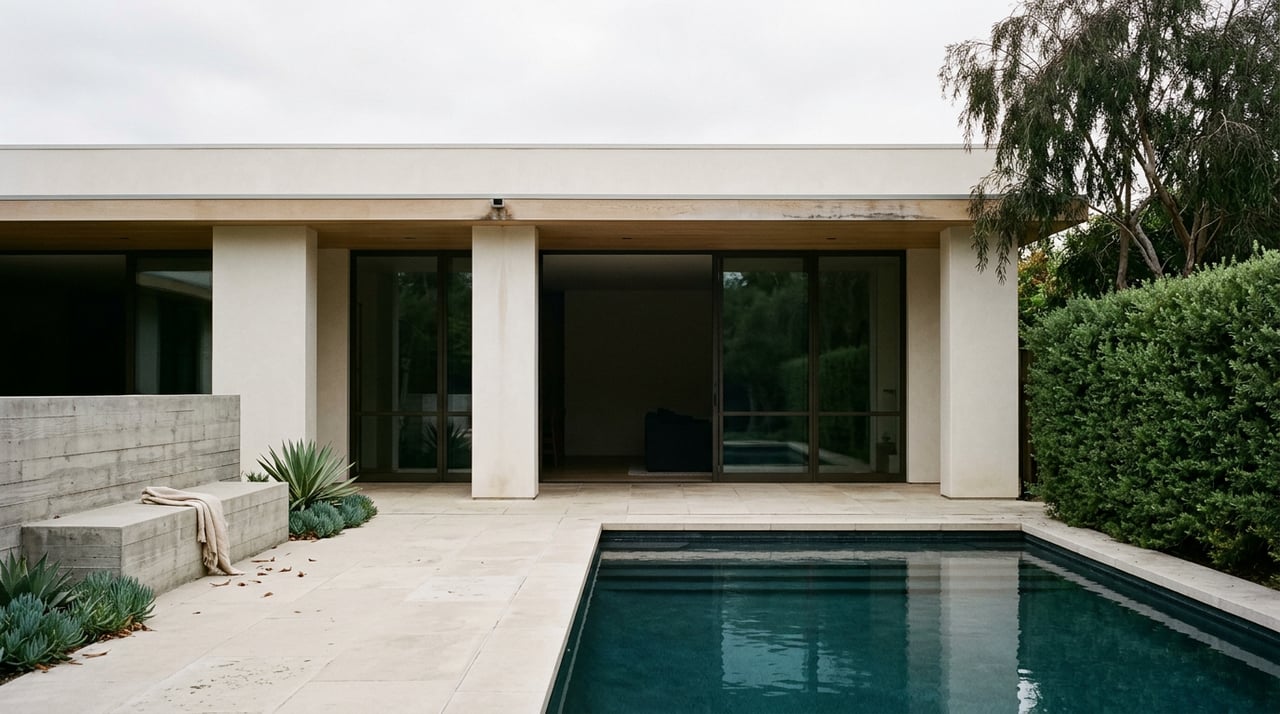
Why the Same Price Tag Costs Six Figures More in Brentwood Than in Beverly Hills
August 27, 2026
August 27, 2026
Picture two nearly identical estates listed at $6 million, both carrying a 90210 mailing address. Same era, same lot size, same proximity to the same schools. One seller closes and walks away with the number their agent projected. The other gets a closing statement with a line item they never modeled: $240,000, according to the City of Los Angeles Office of Finance, with no connection to the home's condition, upgrades, or negotiated price reduction. The difference is that one parcel sits inside the incorporated City of Beverly Hills. The other, despite sharing the same zip code, sits inside the City of Los Angeles.
That line item is Measure ULA, the City of Los Angeles transfer tax that applies to sales above roughly $5.4 million as of July 1, 2026. And the difference between the two sellers has nothing to do with their homes. It has to do with which side of an invisible municipal line each parcel sits on.
That line, not square footage, not lot size, not even zip code, is quietly becoming one of the biggest variables in how Westside sellers price, time, and structure a sale above $5 million. Anyone comparing Brentwood to Beverly Hills, or Pacific Palisades to Santa Monica, on price per square foot alone is missing the number that actually moves at the closing table.
Voters approved Measure ULA in November 2022 and it took effect April 1, 2023. It layers an additional transfer tax on top of the standard city and county documentary transfer taxes, which the Los Angeles County Registrar-Recorder/County Clerk lists at about $5.60 per $1,000 of sale price. The thresholds adjust every July 1 based on the Chained Consumer Price Index. As of July 1, 2026, the tiers are:
| Sale price | Tax rate | Tax owed on the full price |
|---|---|---|
| Below $5,400,000 | 0% | $0 |
| $10,900,000 and above | 5.5% | $599,500 and up |
That middle column is where the story lives. Measure ULA has no marginal bracket. It taxes the entire sale price the moment a transaction crosses the line, not just the amount above it. A home selling for $5,399,999 owes nothing. The same home selling for $5,400,001 owes roughly $216,000. A two-dollar difference in negotiated price can be worth a six-figure difference in seller proceeds, which is why brokers on both sides of a deal now talk about the "cliff effect" as its own line of negotiation.
Run that math against actual equity and it gets sharper. Consider a Bel Air owner who bought for $5 million and lists at $5.5 million. The gain is $500,000. But because Measure ULA taxes gross price, not profit, the 4% tax applies to the full $5.5 million, producing a bill of roughly $220,000, which consumes nearly half of the entire gain from years of appreciation. There is no primary residence exemption. The tax does not care how long you owned the house or what you paid for it.
Measure ULA only applies inside the incorporated City of Los Angeles. That single fact draws a boundary through the Westside that has nothing to do with how a neighborhood feels and everything to do with a city charter.
Brentwood, Pacific Palisades, Westwood, and Bel Air sit inside city limits, so nearly every luxury sale above the threshold in those neighborhoods is exposed. Beverly Hills, Santa Monica, and Culver City are independent, incorporated cities with their own transfer tax structures, and they are simply outside ULA's reach. Santa Monica runs its own separate transfer tax, Measure GS, but it is a different mechanism with different rates, as the City of Santa Monica explains.
The revenue data makes the exposure concrete. Reporting from The Real Deal in early August 2026 found that Brentwood's 90049 ZIP code has generated $125.5 million in Measure ULA revenue across 240 transactions since the tax took effect, the highest single contribution of any residential ZIP code in the city. The 90077 ZIP, covering Bel Air, Holmby Hills, and Beverly Glen, has generated roughly $98 million across 108 transactions. Pacific Palisades ranks as the third-highest residential contributor citywide. Citywide, the tax has produced more than $1.1 billion in total revenue in just over three years, across roughly 1,600 transactions, with single-family residential sales accounting for about 41 percent of that total.
There is a wrinkle worth knowing if you are using zip code as a jurisdiction shortcut. The 90210 ZIP code is not entirely Beverly Hills. Portions of it fall inside City of Los Angeles limits and have contributed meaningfully to ULA revenue on their own, separate from the incorporated city of Beverly Hills next door. A zip code tells you very little. The parcel's actual jurisdiction, which anyone can verify through the Los Angeles County Assessor's property lookup tool, is what determines whether the tax applies at all.
A tax this large, applied this abruptly, changes how people act well before they get to a closing table.
Research from UCLA's Lewis Center for Regional Policy Studies, published in April 2025 and widely cited in coverage of the policy's effects, found that Measure ULA led to a 30 to 50 percent decrease in transaction volume across commercial, industrial, and multifamily assets in the city. On the residential side, separate analysis has pointed to a substantial drop in the likelihood that a home sells above the $5 million mark at all since the tax took effect, as owners either hold rather than trigger the tax or adjust their pricing to land just under it.
That pricing behavior shows up on both ends of the market. On the smaller multifamily side, investors have been steering capital toward five to fifteen unit buildings deliberately priced well under $5.4 million, both to avoid the tax and to leave room for capital improvements without tipping into taxable territory. On the single-family luxury side, the same instinct has fueled a rise in off-market sales, where sellers near the threshold prefer a quiet, controlled negotiation over a public listing that invites price-anchored lowball offers from buyers who know exactly where the cliff sits. An off-market sale does not eliminate the ULA obligation once a price crosses the threshold. It simply gives the seller more control over how that number gets negotiated.
The politics around the tax have moved just as fast as the market has. The California Court of Appeal upheld Measure ULA in December 2025, rejecting a constitutional challenge from the Howard Jarvis Taxpayers Association. On July 6, 2026, the Los Angeles City Council also declined to send a proposed multifamily exemption to voters, instead directing staff to draft a narrower tax credit pilot that has not yet been finalized.
The most personal version of this fight is playing out in Pacific Palisades right now. Following the January 2025 fire, the City Council voted 13 to 1 to place a measure on the November 2026 ballot that would exempt fire victims rebuilding in the Palisades from Measure ULA for five years, since burned lots there are already commanding prices that cross the tax threshold before anything has even been rebuilt.
If you are weighing a purchase or a future sale across Brentwood, Pacific Palisades, Westwood, Beverly Hills, or Santa Monica, the headline median price was never the full comparison. Above roughly $5.4 million, the city line itself is a cost input, and it belongs in the same conversation as school proximity, lot size, and renovation condition.
For sellers approaching that threshold from below, the math around pricing $50,000 or $100,000 under $5.4 million, rather than pushing for a marginally higher number that crosses it, deserves a real calculation before a home ever hits the market. For buyers, understanding that a seller inside city limits is carrying a cost their counterpart in Beverly Hills or Santa Monica never will helps explain some of what looks like inconsistent negotiating behavior at the high end of the Westside market right now.
None of this is a reason to avoid Brentwood, Bel Air, or the Palisades. It is a reason to have someone in your corner who knows exactly which side of the line a property sits on before you set a price.
Does my ZIP code tell me whether Measure ULA applies? Not reliably. Parts of the 90210 ZIP code fall inside City of Los Angeles limits even though most of it is the incorporated City of Beverly Hills. The only way to confirm exposure is to check the parcel's actual jurisdiction through the county assessor's records, not the mailing address.
Is the tax based on my profit or the sale price? The full gross sale price. There is no deduction for what you originally paid, your mortgage balance, or capital improvements, and no primary residence exemption.
Is there any chance this tax goes away soon? The California Court of Appeal upheld it in December 2025. The only ULA-specific 2026 ballot question is a narrow five-year exemption for Pacific Palisades fire victims, not a broader repeal.
If you are trying to figure out what a Westside sale or purchase actually costs once the city line, the threshold, and the timing all factor in, that is exactly the kind of block-by-block analysis Lauren Ravitz works through with clients before a number ever goes on paper. Request Your Westside Home Valuation and get the full picture before you price a home near the line.
This article is general information, not legal, tax or financial advice. Consult a qualified professional about your situation.
Stay up to date on the latest real estate trends.

Lauren delivers a full-service package to each of her clients with her connections to local businesses and influential people, with a finger on the pulse of the Los Angeles lifestyle, and with the outstanding resources at Berkshire Hathaway HomeServices. Lauren holds her relationships with clients in high regard and does so with honesty, integrity, and confidentiality.
11677 San Vicente Blvd Suite 307 Los Angeles CA 90049